A young dentist colleague of mine, taking the smoking history of a highly qualified elderly patient, asked, “Do you smoke?” The gentleman smiled, placed a fatherly hand on my young friend’s shoulder, and said, “Not today, son, I will have a Gold Flake some other time!”
This true incident never fails to raise a chuckle. And, of course, it makes for a great speech opener.
Amusing anecdotes aside, the implication of the patient’s response is no laughing matter. On the contrary, it is a reflection of a rather disturbing issue.
When asked about tobacco habits, the usual expectation from the patient is self-consciousness, denial, avoidance, or sometimes even a blatant lie. That’s not what happened here. In this case, the patient’s first thought was not about the destructive nature of his habit, but about the offering of a cigarette as a friendly gesture!
We, as a nation, have attained political and personal freedom after immense upheavals. However, an infernal monster still enslaves a vast majority in its tentacles.
The monster of fallacies and misconceptions.
Bias, prejudices, myths, and plain bull-headed stubbornness.
What about ignorance?
With all the extensive anti-tobacco awareness campaigns by healthcare professionals, the media, NGOs, and concerned citizens, it is incredible that a person of his educational and social background is unaware of the devastating effects of smoking.
Open any social media platform, and we are deluged with health tips from quacks to super-specialists.
This, ironically, breeds more myths—half-baked ideas festering into ‘full-baked’ fallacies.
For instance, take the classic but pitiful excuse: “Even non-smokers get cancer; if it’s destined, I will get it anyway. So let me smoke in peace.” To that, I usually say: “Yes, even the most careful pedestrian runs the risk of being run over on the street. So, will you cross the road with your eyes closed?”
I win the argument every time. If only I could stop his habit.
Well, that is the whole point. Emotional creatures that we are, cold logic, a ‘risk factor,’ or statistical probability rarely influences our actions. So, when our misconceptions entwine with the chains of addiction, it’s an inevitable drop to the abyss.
Here’s another interpretation of the opening story. Maybe the gentleman was indeed joking. Meeting a friendly young dentist of almost his son’s age, he engaged in some playful banter. Granted, he has a creative take on life and a jovial sense of humour. Well, good for him. However, his response is still undesirable, if not outright objectionable.
Why?
Because the attitude is alarming, the joke is in bad taste, and it was not a social situation.
Far from it.
It was a professional doctor-patient scenario in a hospital where treatment was being rendered. So, it was presumptuous on the part of the patient to initiate familiarity, and that too, with smoking: a harbinger of suffering and a great scourge of humanity. Tobacco is simply not to be trifled with.
Therefore, whether the response stemmed from ignorance or from humour, the implication is of grave concern. Much deeper and subliminal influences hold sway over our mental faculties.
The assortment of our cognitive biases is mind-boggling. No one is immune to them. It’s unavoidable and an integral part of our thinking process. It’s what makes us human. But hubris, coupled with addictions and substance abuse, can become truly dangerous.
Tobacco is injurious to health. Fallacies, born out of biases, make it lethal.
Those beliefs become a part of us. We hold fast to them with a death grip. We are conditioned to defend our identity and our most cherished ideas.
Even the stupid ones.
Especially the stupid ones.
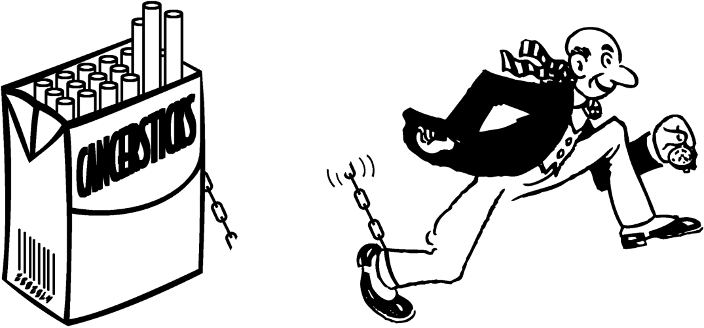
As if it’s the gospel truth. The problem is, this ‘truth’ will not set us free. It will only imprison us in idiocy and a cigarette pack. As long as we are deluded, can we really call ourselves free?
It’s time we expose our fallacies to the light of knowledge, accept their influence, and still make an informed choice.
Thought and reason make us human, and freedom of thought makes us liberated humans. Fallacies are the sirens that misinform, mislead and, at times, murder.
The fight against tobacco addiction and cancer is always an uphill battle, even with the best of resources and manpower. Everyone involved in this great crusade is doing a monumental service to society, to rid the world of heart-breaking morbidity and mortality.
But success still eludes us to the extent that we would like to see. The causes are surely many.
Of these, the callous and casual attitude of smokers is definitely one. This stems from our deeply ingrained belief systems and conditioning. Obviously, it is the expert domain of psychologists, counsellors and sociologists to address this problem as part of the larger war against tobacco, and they are doing a good job.
We can contribute to their sterling efforts by not encouraging such frivolous comments on smoking and other habits in our day-to-day social interactions. On the contrary, we should promptly voice our objections and alert them to the downward spiral of this dangerous attitude.
Yes, they might respond with, “It’s my life, my choice.” Fine, but one does not have the right to spread this poison among one’s friends and family. And yes, save some of that bravado for the chemotherapy drugs.
Anti-tobacco efforts happen in the lawyer’s office, the doctor’s clinic, on the psychiatrist’s couch, in counselling centres, in health camps and in cancer wards.
That is not enough.
Because, as they say, ‘The devil is in the details.’ In everyday conversations, in their body language, and in jokes and casual comments, smokers and would-be tobacco addicts reveal their attitudes and vulnerabilities. We, the non-smokers and anti-tobacco crusaders, caregivers and well-wishers, need to be aware of these tiny cracks and seal them promptly before these cracks transform into chasms of rampaging cancers and untold suffering.
As Hyman Rickover says, ‘The devil is in the details…but so is salvation.’